Pain research &
clinical trials instruments
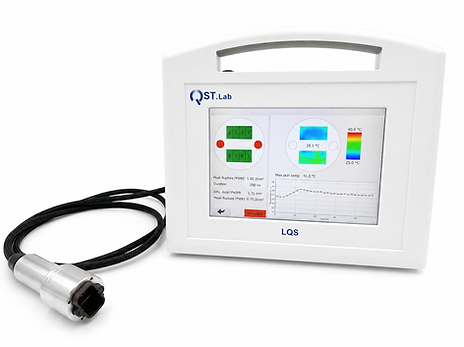
LQS — LASER Cutaneous Stimulator
Class 1C LASER stimulation for LASER-evoked potential research
The LQS — LASER Cutaneous Stimulator is a research instrument developed by QST.Lab for controlled cutaneous thermal stimulation in LASER-evoked potential (LEP), nociception, thermoception, and pain research protocols.
Designed as a Class 1C LASER stimulator, the LQS combines the benefits of LASER-based thermal stimulation with an integrated safety architecture adapted to controlled skin-contact applications.
It provides researchers with a compact, reproducible, and protocol-driven solution for delivering localized thermal stimuli while supporting precise synchronization with electrophysiology acquisition systems.
Optimized for LASER-evoked potentials
The LQS is particularly suited for laboratories working with electroencephalography (EEG) and evoked potential recordings.
A dedicated 0–5 V TTL (Transistor-Transistor Logic) trigger output allows each stimulation to be precisely synchronized with external acquisition systems. This enables accurate temporal alignment between the cutaneous stimulus and the recorded electrophysiological response.
The LQS is therefore well adapted to protocols involving:
-
LASER-evoked potentials (LEPs)
-
Nociceptive pathway assessment
-
Thermo-nociceptive stimulation
-
Pain research
-
Somatosensory research
-
Controlled cutaneous thermal stimulation
LEPs showing the difference in N2P2 wave amplitude for 1, 4, and 8 LEDs
1470 nm LASER LEDs for targeted cutaneous stimulation
The LQS uses 1470 nm LASER LEDs, a wavelength selected for controlled cutaneous thermal stimulation.
At this wavelength, optical energy is strongly absorbed in superficial skin layers. This allows the stimulus to be delivered close to cutaneous sensory fibers while limiting excessive energy penetration into deeper tissues.
This stimulation approach is particularly relevant for activating thermo-nociceptive pathways and recording LASER-evoked potentials.
Advantages of 1470 nm stimulation
-
Superficial and controlled energy deposition
-
Stimulation close to cutaneous sensory fibers
-
Fast and localized thermal stimulation
-
Reduced risk of deep tissue heating
-
Improved repeatability between stimulations
-
Reduced risk of skin burns when used within the device’s safety limits
-
Suitable integration into electrophysiology and pain research protocols
Alternative wavelengths may also be proposed on request, depending on the scientific protocol and target tissue interaction required.
Why Class 1C matters
The Class 1C classification is especially relevant for laboratories using LASER stimulation on the skin.
It allows controlled optical energy to be delivered to the target tissue while integrating safety mechanisms that limit exposure conditions and reduce operational risks.
For research teams, this provides several practical advantages:
-
Safer use in experimental workflows compared with open-beam LASER configurations
-
Controlled skin-contact stimulation
-
Reduced need for complex LASER-room constraints, depending on local safety rules and institutional procedures
-
Improved usability for repeated experimental sessions
-
Easier integration into neurophysiology laboratories
-
A compact and practical alternative to traditional high-class LASER stimulation systems
Controlled and reproducible thermal stimulation
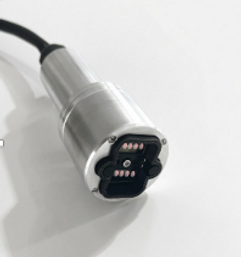
The LQS stimulation probe includes eight independent 1470 nm LASER LEDs, allowing flexible stimulation configurations and precise control of the stimulated area.
Users can define stimulation parameters directly from the touchscreen interface or through USB/serial computer control.
Main stimulation features
-
8 independent 1470 nm LASER LEDs
-
Beam surface:
-
1 LED: 0.21 cm²
-
8 LEDs: 1.70 cm²
-
-
Adjustable stimulation duration
-
Adjustable energy density
-
Selection of active diodes
-
Infrared skin temperature monitoring
-
Touchscreen interface
-
Custom protocol creation
-
USB/serial control for automated experiments
-
0–5 V TTL trigger input/output
-
CSV data recording and export
-
Autonomous battery operation
-
Optional alternative wavelengths on request
Integrated safety architecture
The LQS includes built-in safety functions designed to support controlled laboratory use.
Safety features include
-
Startup self-test of the LASER LEDs
-
Power-density and stimulation-duration limitation
-
Real-time energy monitoring
-
Automatic stimulation interruption
-
Galvanic insulation
-
Skin-contact detection
These functions help researchers deliver repeatable stimuli while maintaining controlled exposure conditions during experimental sessions.
Flexible protocol-based operation
The LQS allows users to create and execute custom experimental protocols directly from the device.
Protocol steps can include:
-
Stimulation events
-
Waiting periods
-
Trigger input or output
-
Response-button events
-
Repetitions
-
Data recording
Recorded data are stored in CSV format and can be exported via USB for further analysis.
Key benefits
-
Designed for LASER-evoked potential research
-
Class 1C LASER architecture for controlled skin-contact use
-
1470 nm wavelength for superficial cutaneous stimulation
-
Eight independent LASER LEDs for flexible stimulation areas
-
TTL synchronization with EEG and external acquisition systems
-
Protocol-based operation for reproducible experimental workflows
-
Integrated safety functions
-
Compact, practical, and suitable for repeated laboratory use


Left: Activation of the 8 LEDs by selection. Right: Visualization of the stimulated areas via infrared camera, as well as changes in skin temperature.
Left: Activation of the 1 LED by selection. Right: Visualization of the stimulated areas via infrared camera, as well as changes in skin temperature.