
Protocols
Sensory testing methods in the TCS
Method of limits
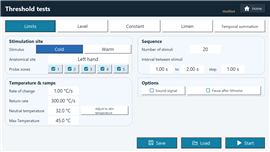
Principle
Temperature changes progressively from a neutral temperature. The participant presses the response button when the sensation specified in the instructions is perceived. The temperature at the response is recorded for that trial. Repeated warm or cold ramps provide a threshold estimate.
Parameters available in the TCS
Direction, active zones, neutral temperature, ramp rate, number of stimuli and intervals.
Adaptive level method
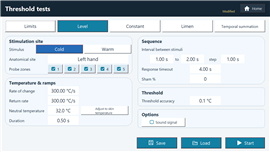
Principle
The software presents discrete stimuli. The participant reports detection within a response window. Subsequent intensities depend on previous responses. The algorithm reduces the step after response reversals and increases it during repeated same-direction responses to refine the threshold estimate.
Parameters available in the TCS
Stimulus duration and rates, intervals, response window, sham trial proportion (Sham %) and minimum estimation step (Threshold accuracy).
Method of constant stimuli
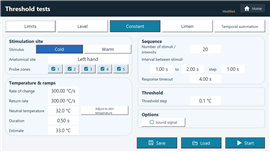
Principle
Discrete stimuli are presented at ten intensity levels around a preliminary threshold estimate, obtained for example with Limits or Level. Each level is repeated as specified. Detection responses characterize the relationship between thermal intensity and detection probability as a psychometric function.
Parameters available in the TCS
Initial estimate, intensity step, repetitions per intensity, duration, rates, intervals and response window.
Thermal sensory limen
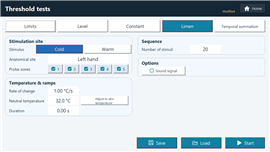
Principle
Temperature alternates towards warmth and cold. Each participant response reverses the direction, optionally after a hold, without systematically returning to neutral. The difference between the two sensory thresholds characterizes the thermal sensory limen.
Parameters available in the TCS
First direction, active zones, neutral reference, rate, number of stimuli and hold duration before reversal.
Temporal summation
Principle
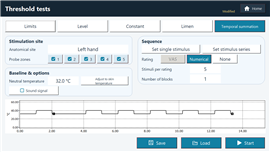
The protocol combines a single stimulus and a stimulus series, with optional block repetitions. Sensations can be rated with an eVAS visual analogue scale or numerical input. This allows the change in sensation during repeated stimulation to be studied; it is not a threshold estimation method.
Parameters available in the TCS
Single stimulus and series profiles, number of stimuli, intervals, rating mode and frequency, and number of blocks.
Build a protocol
The Custom protocols module combines steps including stimulation, threshold tests and ratings. Parameters are defined according to your research protocol.
Discover TCS →Based on the TCS 2.2 manual, September 2026 edition, sections 6.5 and 6.6. English labels correspond to the software tabs.