Thermal cutaneous stimulation
TCS 2.2
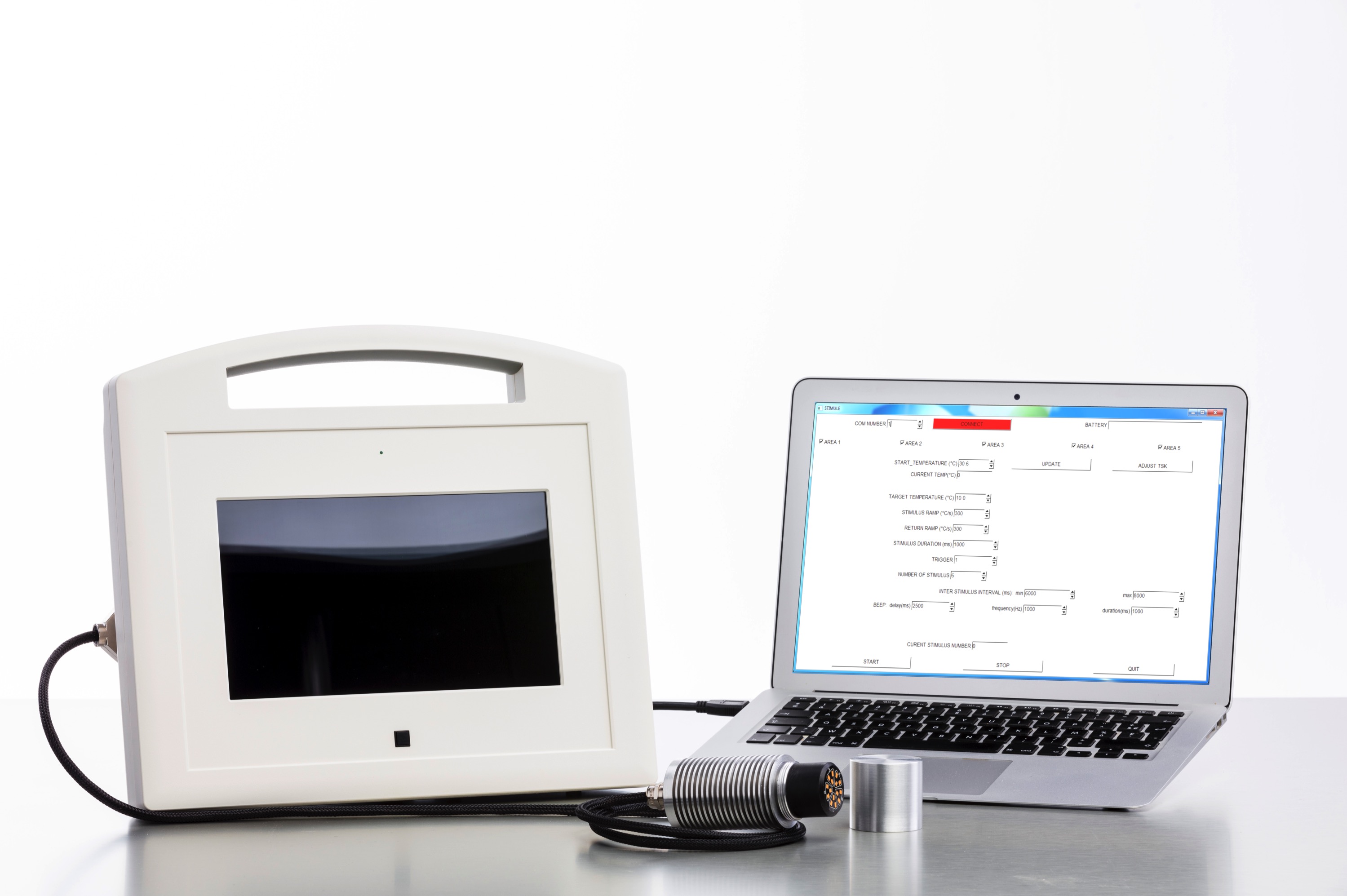
The TCS 2.2 is a quantitative sensory testing stimulator for controlled heating and cooling through contact thermodes in sensory and pain research.
Request information ↗Technical specifications ↓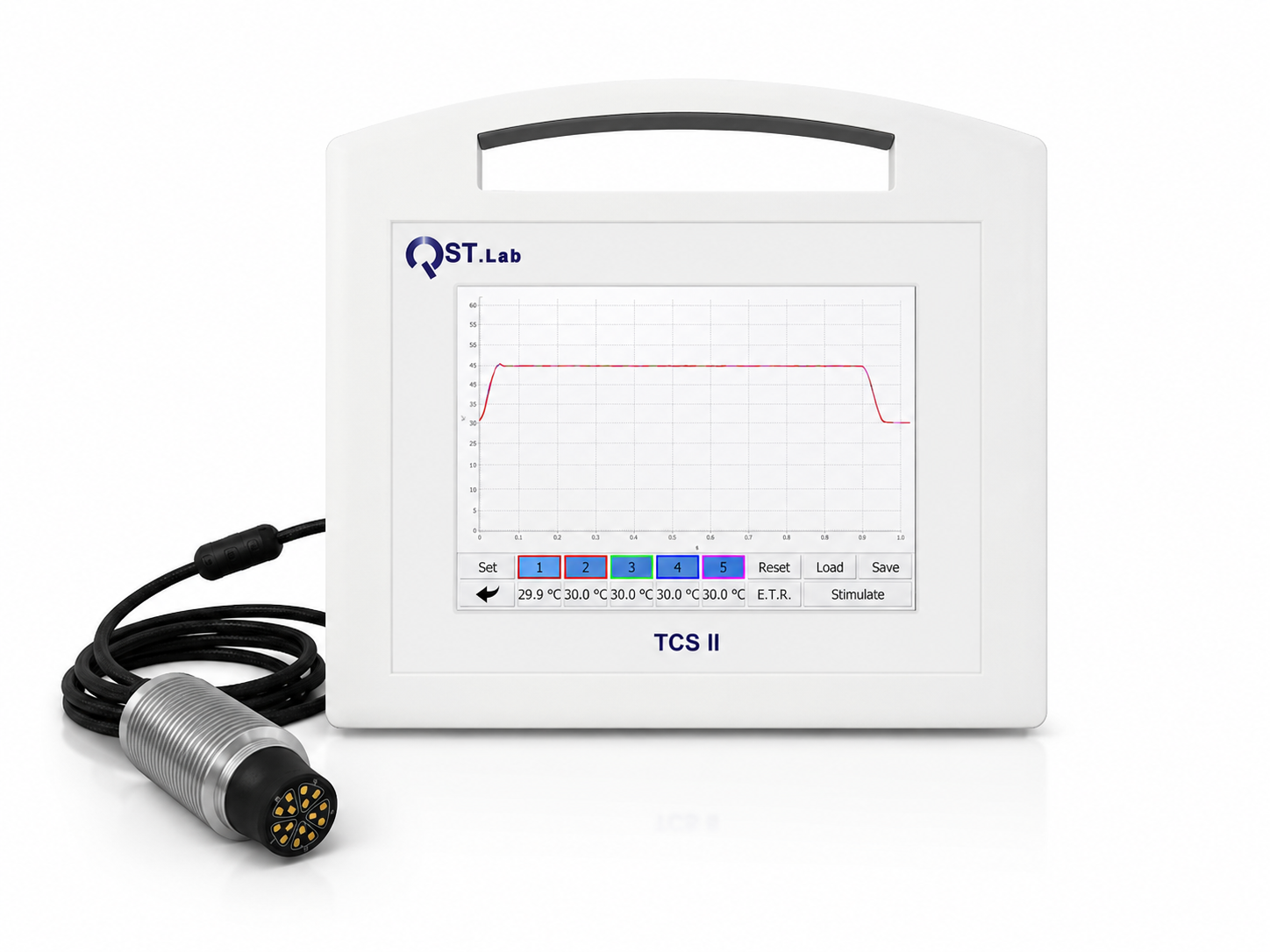
Thermal quantitative sensory testing (QST)
The TCS 2.2 uses Peltier-based contact thermodes and closed-loop temperature regulation. It supports warm and cold detection, thermal pain thresholds, temporal summation, CHEPs and CEPs.
- Independent temperature settings for multi-zone thermodes
- Real-time monitoring and automatic calibration
- Touchscreen operation or computer-driven sequences
- TTL synchronisation with electrophysiology acquisition
In thermal QST protocols, controlled temperature changes are paired with the participant’s reported detection or pain thresholds. Contact heat-evoked potentials (CHEPs) and cold-evoked potentials (CEPs) are separate applications using electrophysiological recordings.
See research publications using QST.Lab instruments and eVAS response measurement accessories.
Technical specifications
- Temperature range
- 0 °C to 60 °C
- Temperature precision
- 0.1 °C
- Ramp rate
- 0.1 °C/s to a maximum of 300 °C/s, depending on thermode
- Zones
- Five independently controlled zones, depending on probe configuration
- Control
- Touchscreen; USB/serial computer control
- Synchronisation
- TTL trigger input/output
- Data
- CSV recording and export
- Power
- Battery-powered; stimulation disabled during charging
- Weight
- 3 kg
- Cooling
- No water cooling
Compatible thermodes
Select a stimulation surface and ramp rate for your protocol. MRI-compatible thermodes are also available.
Compare thermal probes ↗Integrated safety functions
- Startup self-test and temperature/duration limits
- Real-time temperature monitoring and automatic interruption
- Safety monitoring of the relationship between stimulation temperature and duration
- Galvanic insulation for external connections
Computer-driven experiments